


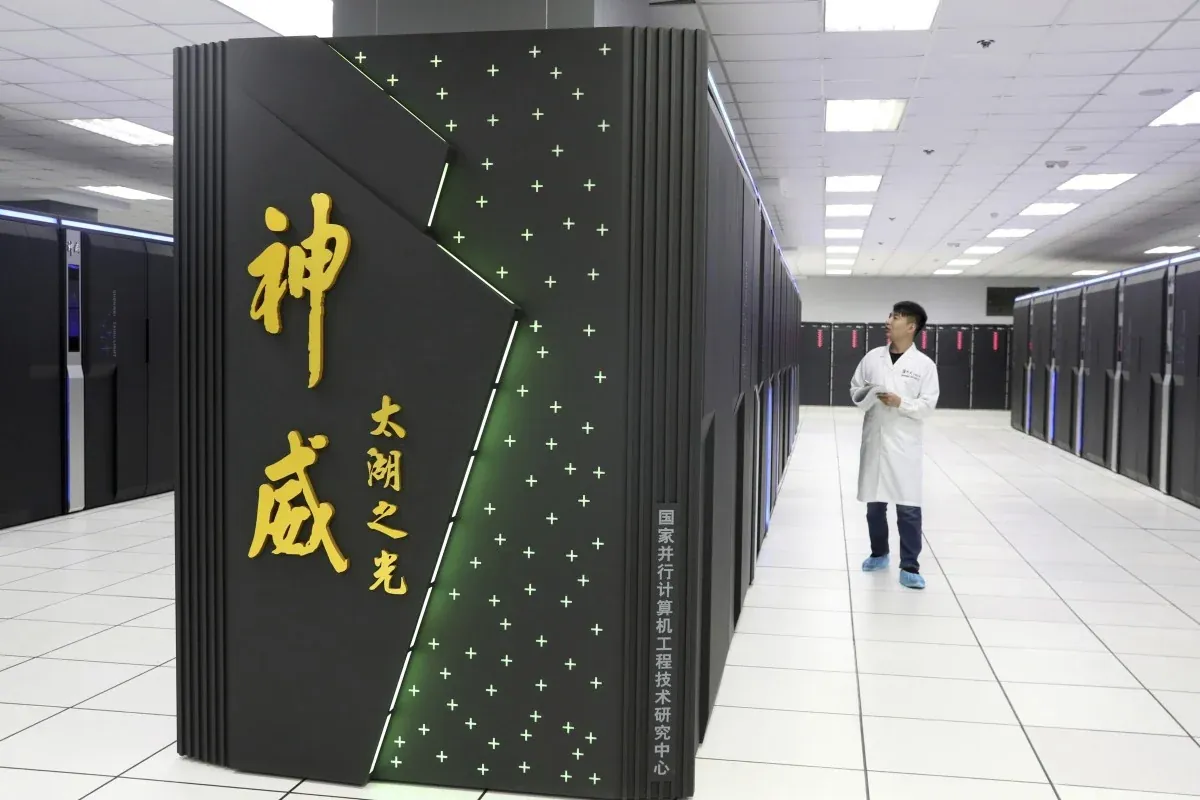
China’s announcement of a new supercomputer might sound like a niche technical development. In reality, it points to a much larger shift in the global technology landscape.
At the center is the “Lingshen” project, presented by a supercomputing center in Shenzhen. The goal is ambitious: more than two exaflops of computing power—without relying on GPU accelerators or Western core technology. Instead, the system is expected to run entirely on domestically developed processors, scaled up to an extreme degree.
That alone makes it noteworthy. Modern high-performance computing has, for years, followed a clear trajectory. Systems like the El Capitan Supercomputer rely heavily on GPUs because they are far more efficient at handling parallel workloads, especially in artificial intelligence and large-scale simulations.
China is deliberately stepping away from that model.
This is not primarily a technical preference—it is a geopolitical constraint. Access to advanced chips has been increasingly restricted, particularly from companies such as Nvidia and AMD. The result is not a temporary workaround, but the emergence of an alternative technological path.
Put simply, when the most efficient option is no longer available, a different system has to be built—even if it appears less elegant at first glance.
Exascale computing itself is not just about raw performance. It underpins capabilities in AI development, climate modeling, advanced materials research, and defense-related simulations. These are not marginal applications; they are strategically relevant across entire industries and governments. Leadership in computing capacity increasingly translates into broader technological and economic leverage.
At the same time, skepticism is warranted. Many aspects of the “Lingshen” system remain unclear. There are no independent benchmarks yet, no detailed performance comparisons, and limited transparency regarding the actual capabilities of the processors involved. Chinese systems have historically struggled to match the absolute top tier of Western hardware in certain areas.
But that may be missing the point.
The real significance lies not in whether this system immediately outperforms its Western counterparts. It lies in the fact that China is demonstrating a viable path toward high-end computing without relying on Western supply chains. That alone changes the strategic equation.
For internationally active companies, this shift is highly relevant. The global economy is gradually moving toward parallel technological ecosystems. Decisions about market entry, partnerships, and supply chains are becoming more political, not less. Access to technology is no longer guaranteed—it depends on alignment, geography, and regulation.
Another important implication is the changing role of efficiency. A system that is technically less optimized can still be strategically superior if it is independent and controllable. This trade-off is no longer confined to computing. It is visible in energy systems, industrial policy, and manufacturing strategies across multiple regions.
What we are seeing is not the end of globalization, but its transformation. Integration is giving way to fragmentation, and economic logic is increasingly shaped by political boundaries.
The Chinese supercomputer project is not an isolated development. It is a signal. Technological systems are beginning to diverge, and the global business environment is adjusting accordingly.
For companies operating across borders, that means one thing above all: international expansion is becoming more complex—and far more strategic.
Can you afford not to be in China? Talk to us, we’ll help you succeed in China.