


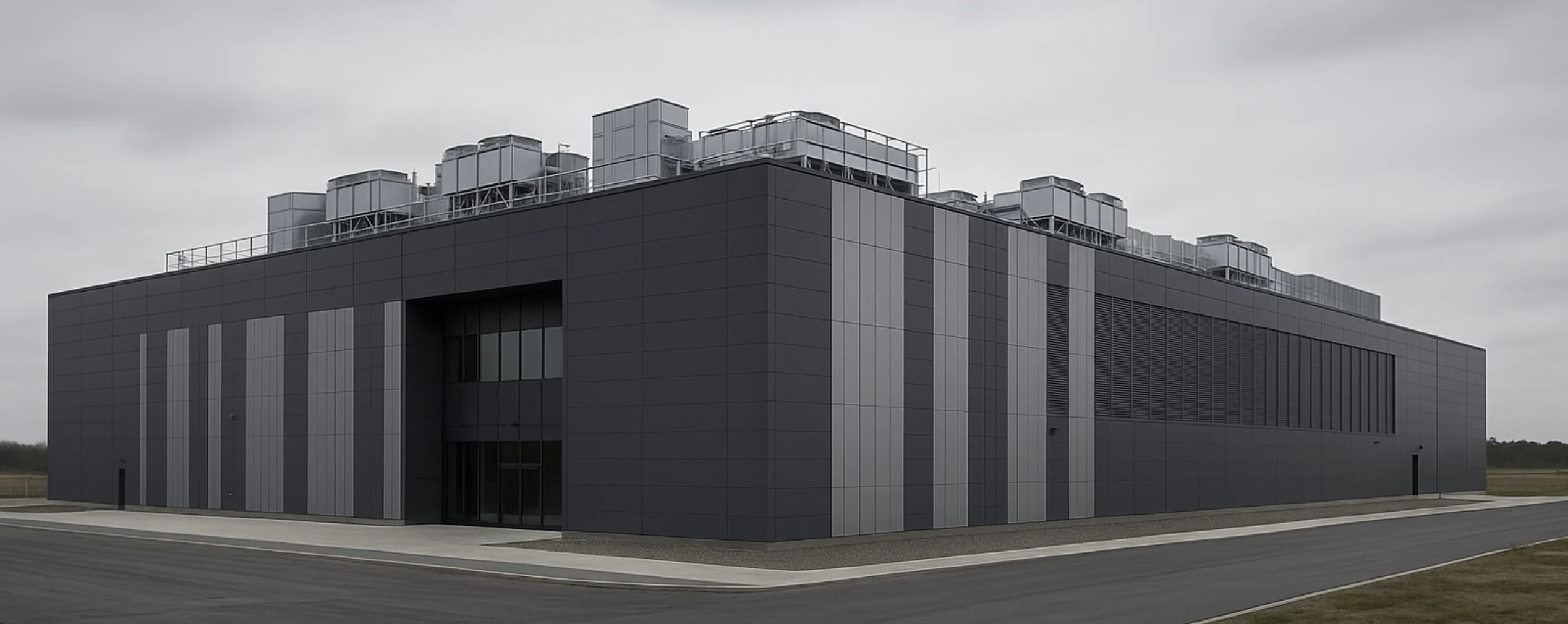
In the world of infrastructure, some shifts happen quietly, while others arrive with the force of a moving tectonic plate. In Germany’s industrial heartlands, a new playbook for AI investment is being written: If you want to operate at scale, you must master your own power.
The traditional “utility” model of the data center—where a developer simply rents a building and plugs into the local grid—is reaching its breaking point. We are entering an era of “Infrastructure Realism,” where digital growth is dictated by physical constraints.
The Grid Crisis: From Frankfurt to Brandenburg
The relationship between a data center and the power grid is undergoing a fundamental transformation. A modern AI inference cluster isn’t just another industrial consumer; it draws between 10 to 50 megawatts (MW) continuously—the equivalent of powering a small city.
As traditional hubs like Frankfurt am Main reach their physical and electrical limits, the focus is shifting toward Eastern Germany. Regions like Saxony-Anhalt and Brandenburg offer land and proximity to renewable energy, but even there, grid operators like Mitnetz Strom are bracing for the impact. They are seeing an unprecedented wave of connection requests that require a total rethinking of high-voltage infrastructure.
The Schwarz Model: A Retail Giant Becomes a Tech Titan
Nowhere is this shift more evident than with the Schwarz Group (the parent company of Lidl and Kaufland). Through Schwarz Digits and its cloud platform STACKIT, the group is building what can only be described as a sovereign European digital fortress.
Their recent €11 billion investment in a massive data center project in Lübbenau is a landmark for German infrastructure. Designed to house 100,000 GPUs for large-scale AI training, this project highlights a specific strategic pivot:
-
Digital Sovereignty: Keeping data strictly within German and Austrian borders.
-
Vertical Integration: By building their own massive infrastructure, Schwarz moves away from dependency on US-based hyperscalers.
-
Scalability: Ensuring they own the “pipeline” to feed the massive energy demands of future AI models.
The Financial Logic: Owning the Source
For a Chief Financial Officer, the decision to invest in heavy energy infrastructure—such as dedicated substations or direct renewable generation—is no longer “scope creep.” It is the only way to protect long-term margins.
-
Direct Control: Operators avoid the volatility of grid pricing and “peak load” surcharges.
-
Strategic Payback: While initial Capex is significant, the Levelized Cost of Energy (LCOE) eventually drops well below market rates, creating a 20+ year margin advantage that “renting” competitors cannot match.
-
Physical Resilience: In the race for AI supremacy, the winners will be those who secured their power supply and transmission capacity while their competitors were still waiting for a grid connection.
Sovereignty is a Physical Asset
The data center of 2030 will not be a passive utility customer. It will be a sophisticated energy manager that happens to process data. The massive expansion of companies like Schwarz into the German countryside proves that digital sovereignty is not just a legal or software concept; it is a physical asset.
For enterprise leaders and infrastructure investors, the question is no longer “How much does the power cost?” but rather “Do we own the source?” In the AI era, those who build their own power, win.
Can you afford not to enter the German market? Talk to us, we’ll help you succeed in Germany.
Talk to us →