


For decades, Brazil’s automotive market was dominated by American, European, Japanese and South Korean manufacturers.
Volkswagen, Fiat, General Motors and Toyota shaped the industry for generations. Chinese brands were largely absent from serious discussions about the future of mobility in Latin America.
That reality changed rapidly.
In 2025, Chinese automakers became the dominant force in Brazil’s electrified vehicle market. BYD alone accounted for roughly 72 percent of electrified vehicle sales in the country.
Six of the ten leading electrified vehicle brands in Brazil were Chinese.
The Rapid Rise of Chinese EV Brands
The speed of this transformation surprised many observers. Yet from a global perspective, the trend was already visible.
Chinese automakers spent years building advantages in battery technology, vertical integration, production scale and cost efficiency.
As electric vehicles became more competitive internationally, Latin America emerged as one of the most promising expansion markets.
Brazil naturally became the centerpiece.
Why Brazil Matters
The country combines the largest automotive market in Latin America with a substantial industrial base and growing demand for electrified vehicles.
It also offers something increasingly important for manufacturers: access to cleaner electricity and proximity to critical mineral resources linked to battery production.
Chinese companies entered the market aggressively, but not blindly.
Their strategy in Brazil has been notably more sophisticated than simple export-driven expansion.
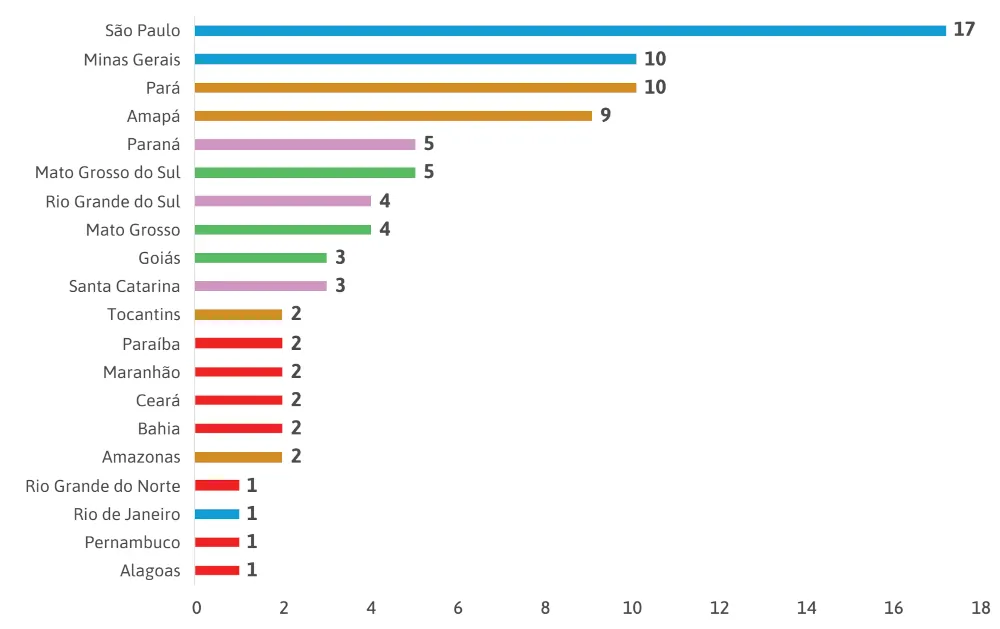
Chinese Investment projects per state in Brazil. Most projects are in São Paulo state, we can help you in Brazil, especially in São Paulo.
BYD, GWM and Geely Expand Production
BYD illustrates this particularly well.
The company acquired the former Ford industrial complex in Bahia and began producing electrified vehicles locally in 2025.
This was symbolically important because it represented not just the arrival of a new manufacturer, but the replacement of older industrial structures with a new generation of automotive production.
GWM followed a similar path by expanding operations through a former Mercedes-Benz facility in São Paulo state.
Geely deepened its Brazilian presence through a partnership with Renault involving local production and technology sharing.
Localization Is Central to the Strategy
Chinese automakers are no longer treating Brazil merely as an export destination.
They increasingly view the country as a manufacturing platform capable of serving both domestic demand and potentially broader regional markets.
Localization has become central to their approach.
Brazil is a difficult market to navigate. Taxes are complex, regulations vary and logistics challenges are substantial.
Companies that rely entirely on imported products often struggle to compete long term.
Chinese firms appear to understand this clearly.
Marketing and Cultural Integration
Many companies are investing not only in factories, but also in branding, marketing and local identity.
BYD has emphasized slogans portraying itself as part of Brazil’s industrial future.
Other companies have partnered with Brazilian celebrities and national marketing campaigns designed to strengthen consumer familiarity and trust.
This localization strategy extends beyond advertising.
Chinese companies are building dealership networks, service infrastructure and local supplier relationships.
Technology and Vertical Integration
Technology plays a major role in their success.
Chinese automakers currently benefit from strong control over battery supply chains, which remain the most critical component of electric vehicle production.
China dominates much of the global battery ecosystem, from mineral processing to battery manufacturing capacity.
This vertical integration gives Chinese firms significant advantages in pricing and production speed.
Western automakers often remain tied to older organizational structures, slower development cycles and fragmented supplier systems.
Chinese companies, by contrast, tend to move faster and adapt more aggressively to market shifts.
Supply Chain Opportunities
The implications extend far beyond car sales.
Electric vehicles require entirely new industrial ecosystems involving batteries, charging infrastructure, software, renewable energy integration and mineral supply chains.
As Chinese firms expand in Brazil, they are helping reshape multiple industries simultaneously.
This creates opportunities for suppliers across sectors such as industrial automation, energy systems, chemicals, logistics and infrastructure.
Challenges Ahead
There are still challenges ahead.
Infrastructure for electric vehicles remains underdeveloped in many parts of Brazil. Charging networks must expand significantly.
Local supplier ecosystems are still evolving. Economic volatility and regulatory uncertainty remain ongoing concerns.
Trade policy may also become more complicated in coming years as governments respond to the rapid expansion of Chinese automotive exports and manufacturing.
Conclusion
Chinese automakers are no longer fringe players in Brazil. They are becoming central actors in the future of the country’s automotive industry.
What is happening today in Brazil may eventually resemble transformations already taking place in parts of Asia and Europe, where Chinese EV manufacturers moved from low-cost outsiders to major industrial competitors within remarkably short periods of time.
Brazil may ultimately evolve into China’s primary electric vehicle manufacturing hub for Latin America.
Can you afford not to enter the Brazilian market? Talk to us, we’ll help you succeed in Brazil.
Talk to us →