


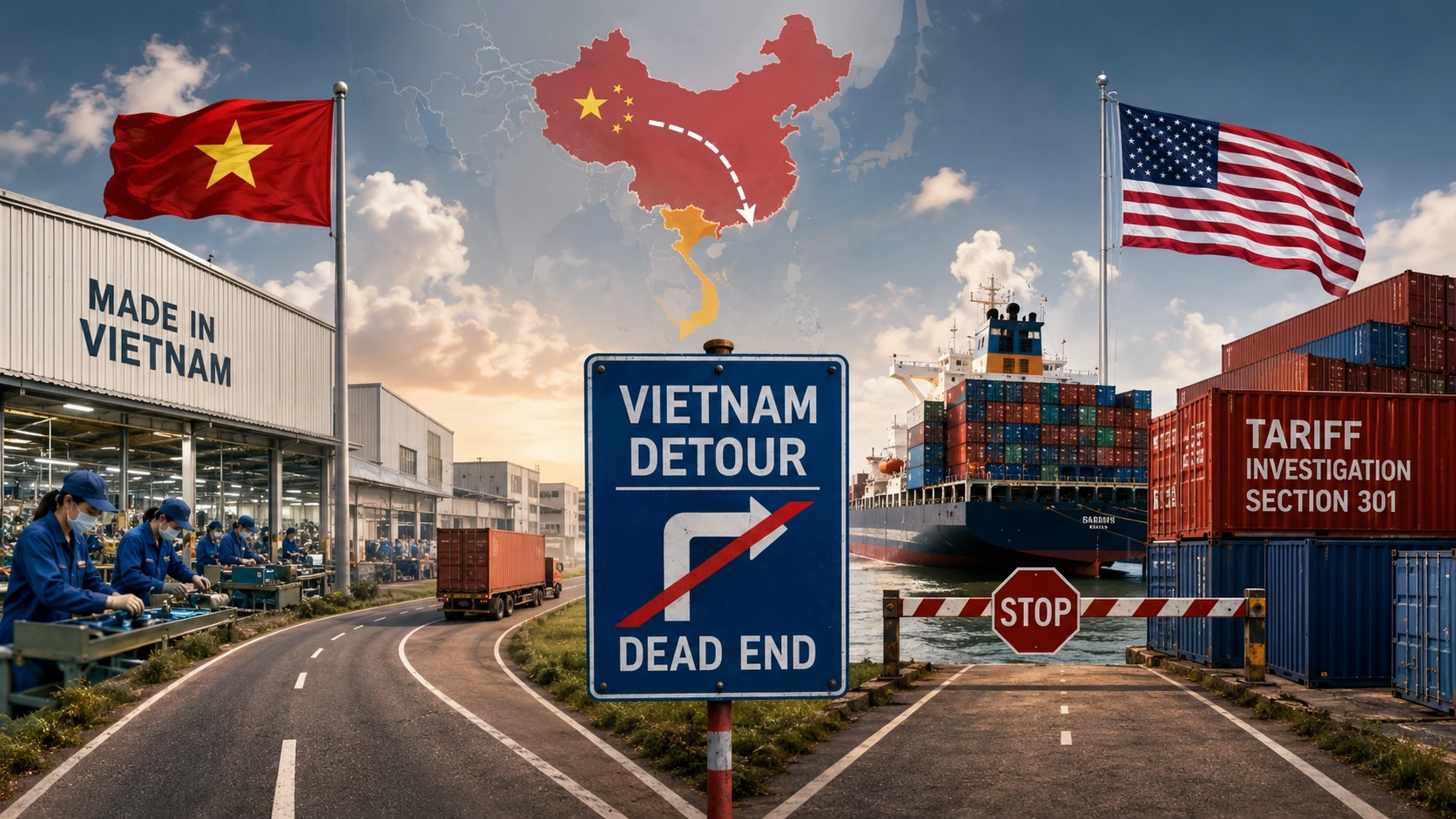
For much of the past decade, Vietnam was seen as the obvious answer to one of the biggest questions facing Chinese exporters: how can companies maintain access to the American market while reducing exposure to tariffs and geopolitical tensions?
The solution appeared straightforward. Move production south, establish factories in Vietnam, export goods from a different country, and continue supplying customers in the United States.
For years, the strategy worked.
Billions of dollars in Chinese investment flowed into Vietnam. Industrial parks expanded rapidly. New factories appeared along the country’s northern manufacturing corridor. Global supply chains adapted, and Vietnam emerged as one of the biggest beneficiaries of the growing economic rivalry between Washington and Beijing.
Today, however, the foundations of that model are beginning to crack.
A growing number of Chinese companies are discovering that relocating production is no longer enough to escape geopolitical risk.
From Manufacturing Haven to Trade Target
Vietnam’s rise as a manufacturing hub was one of the defining economic stories of the last decade.
As tariffs on Chinese goods increased during the first Trump administration, multinational corporations and Chinese manufacturers alike accelerated investments across Southeast Asia. Vietnam offered competitive labor costs, political stability, improving infrastructure, and most importantly, easier access to Western markets.
The country quickly became a critical node in global supply chains.
Factories producing electronics, textiles, furniture, machinery, and solar components expanded rapidly. Exports surged. Foreign investment poured in.
Yet success created its own problems.
As Vietnam’s trade surplus with the United States grew, it increasingly attracted the attention of policymakers in Washington. What was once viewed as an alternative manufacturing base gradually became a target of scrutiny itself.
The logic was inevitable. If production simply moved across a border while ownership, components, and supply chains remained largely unchanged, critics argued that the underlying trade imbalance had not truly disappeared.
The Limits of “China Plus One”
For years, the phrase “China Plus One” became a favorite strategy among multinational corporations.
The concept was simple: maintain a presence in China while establishing additional production capacity elsewhere. Vietnam became one of the most popular destinations for this diversification strategy.
However, recent developments suggest that the next phase of globalization may require something more substantial than geographic relocation.
Governments are paying increasing attention to where products are actually made, where value is added, where components originate, and who ultimately controls production.
A factory located outside China no longer automatically avoids geopolitical scrutiny if its supply chain remains deeply connected to the Chinese industrial ecosystem.
This represents a significant shift in how global trade is evaluated.
The question is no longer where a product ships from.
The question is where it is genuinely produced.
The Rise of Rules-of-Origin Economics
As global trade becomes more politicized, rules of origin are becoming increasingly important.
Products assembled in one country using components sourced elsewhere face growing examination from regulators seeking to identify the true source of value creation.
This trend is forcing manufacturers to rethink their international strategies.
Simple assembly operations designed primarily to change a product’s country-of-origin label may no longer provide the protection they once did. Instead, companies are being pushed toward deeper localization, including local sourcing, local management, local suppliers, and more integrated manufacturing ecosystems.
In many cases, this requires significantly larger investments than merely opening an assembly plant.
The era of easy supply-chain arbitrage appears to be fading.
A New Phase of Globalization
The broader lesson extends beyond Vietnam.
Countries across Southeast Asia, Latin America, and even parts of Europe have benefited from efforts to diversify manufacturing away from China. Yet many are discovering that diversification alone does not eliminate geopolitical risk.
Trade policy is increasingly driven by strategic considerations rather than purely economic ones.
Industries linked to semiconductors, renewable energy, batteries, telecommunications, and advanced manufacturing now sit at the intersection of economics and national security.
As a result, governments are examining supply chains more closely than at any point since the end of the Cold War.
The result is a new form of globalization.
Production is still moving across borders, but companies are increasingly expected to create genuine local value rather than simply shifting final assembly operations.
China’s Next Global Strategy
Chinese companies are adapting.
Rather than searching for the next low-cost jurisdiction that can serve as a tariff shelter, many firms are investing in more comprehensive international operations. This includes local procurement networks, local management teams, regional research capabilities, and production facilities designed to serve multiple markets rather than a single export destination.
The objective is no longer to disguise origin.
It is to become genuinely global.
For companies with long-term ambitions, this may ultimately prove to be a more resilient strategy.
Conclusion: The Shortcut Is Disappearing
Vietnam is unlikely to lose its importance as a manufacturing center. The country possesses a skilled workforce, strong export infrastructure, and a strategic location within Asia.
What is changing is the assumption that relocating production automatically removes geopolitical exposure.
The world is entering an era in which supply chains are judged not only by efficiency and cost, but also by transparency, ownership, strategic relevance, and national security considerations.
For Chinese manufacturers, the lesson is becoming increasingly clear.
The age of the simple tariff detour is ending.
The future belongs to companies capable of building truly international industrial ecosystems rather than merely relocating factories across borders.
Can you afford not to expand abroad Talk to us, we’ll help you grow your business internationally.