


As more American companies expand internationally, one challenge often gets overlooked until it creates problems:
international payments.
Many US businesses entering Europe focus heavily on sales, hiring, logistics, and compliance — but underestimate how important local payment infrastructure can become.
That is where IBANs enter the picture.
What is an IBAN?
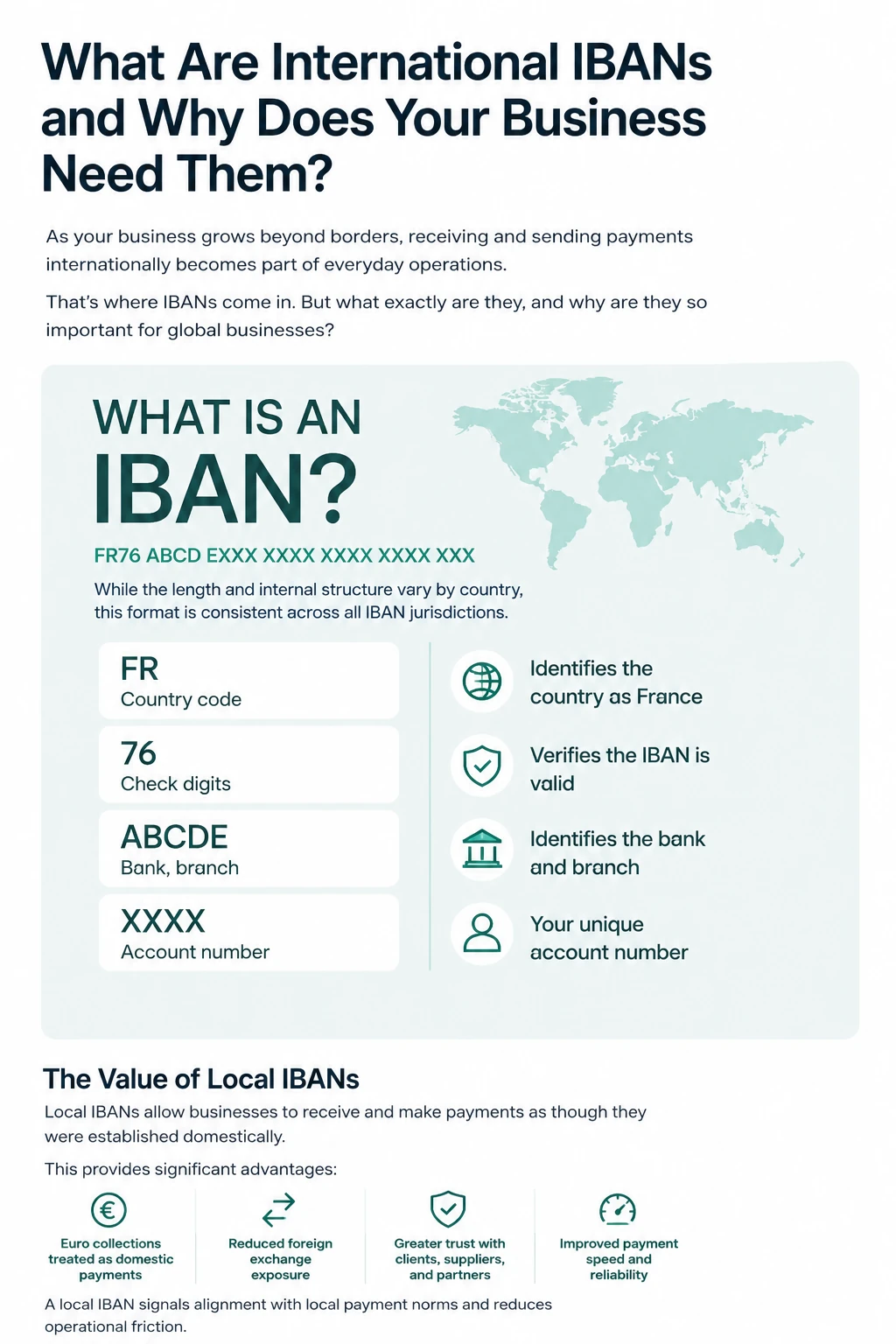
IBAN stands for International Bank Account Number.
It is a standardized banking format used throughout most of Europe and many other parts of the world to simplify cross-border payments.
A European IBAN follows a country-specific structure.
For example, a German IBAN typically looks like this:
DE89 XXXX XXXX XXXX XXXX XX
The structure follows a standard format:
- DE identifies Germany as the country
- 89 are validation check digits
- The remaining characters identify the bank and account information
While the exact length and internal structure vary between countries, the IBAN framework itself is standardized internationally.
Why local European IBANs matter for US companies
For American businesses expanding into Europe, local banking infrastructure can become surprisingly important.
European customers, suppliers, and business partners are accustomed to domestic payment systems and local banking formats.
Having a local European IBAN can make your business appear significantly more established and trustworthy.
Germany is a particularly good example.
As Europe’s largest economy and one of the continent’s most important industrial and commercial hubs, Germany is often used as an entry point for broader EU expansion.
A local German IBAN allows businesses to operate more naturally within the European payment ecosystem, especially within the SEPA network.
This often results in:
- Faster euro payments
- Lower transaction costs
- Reduced foreign exchange exposure
- Improved payment reliability
- Simpler accounting and reconciliation
International growth creates payment complexity
Most companies only notice payment infrastructure when something goes wrong.
Delayed transfers, rejected payments, compliance checks, unexpected FX fees, or supplier concerns can quickly become operational problems as businesses scale internationally.
This becomes increasingly relevant for:
- SaaS companies serving European customers
- E-commerce businesses selling into the EU
- Manufacturers sourcing from Europe
- Import/export companies
- US firms opening European subsidiaries
As international operations grow, local IBANs become less of a convenience and more of a competitive advantage.
Germany as a gateway into Europe
Many American companies use Germany as a base for broader European expansion.
The country offers access to the EU single market, advanced logistics infrastructure, strong industrial networks, and one of Europe’s largest B2B economies.
From Germany, businesses can efficiently serve customers across the European Union while operating within familiar European payment systems.
In practice, this means that local banking infrastructure can support not only payments, but also trust, operational efficiency, and scalability.
The rise of modern global banking infrastructure
Traditionally, obtaining local banking access abroad required opening full domestic bank accounts — often involving lengthy onboarding, significant compliance requirements, and substantial bureaucracy.
Today, newer financial infrastructure providers are changing that model.
Businesses can increasingly obtain local IBANs in countries such as Germany, the Netherlands, Luxembourg, or the UAE without opening traditional local bank accounts in every jurisdiction.
This type of financial infrastructure often stays invisible in the background.
Yet it is becoming increasingly important as more companies operate globally from day one.
The hidden infrastructure behind international business
International expansion is no longer only about selling products abroad.
It increasingly depends on how efficiently companies can move money, manage currencies, reduce friction, and integrate into local financial systems.
In that environment, something as seemingly technical as a local European IBAN can have a surprisingly large impact on operational efficiency, customer trust, and long-term growth.
For many US businesses entering Europe, it may become one of the most underrated tools in international expansion.
Can you afford not to enter the German market? Talk to us, we’ll help you succeed in Germany.
Talk to us →