


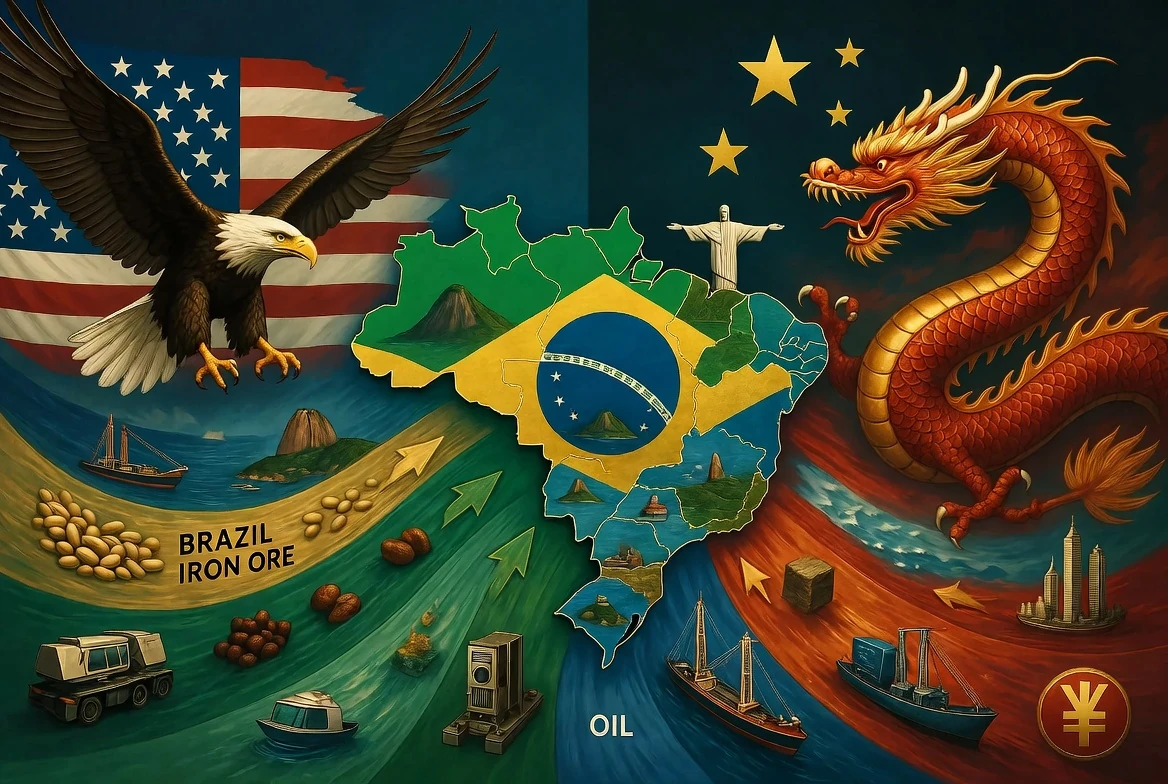
Brazil is undergoing a quiet but profound shift in its geopolitical and economic orientation. Under President Luiz Inácio Lula da Silva, the country is deepening its engagement with China while simultaneously entering periods of friction with the United States. The result is not a clean realignment, but a layered and increasingly complex dependency structure that ties Brazil’s economy, infrastructure, and strategic sectors to competing global powers.
At the center of this transformation is trade. China has become Brazil’s dominant economic partner, absorbing vast quantities of iron ore, soybeans, crude oil, and other primary commodities. This demand has reinforced Brazil’s role as a global supplier of raw materials, supporting export revenues but also consolidating a structural imbalance: commodities flow outward, while manufactured goods and industrial inputs flow inward.
Over time, this pattern has implications that go beyond trade statistics. It shapes industrial capacity, investment flows, and even the direction of domestic development. As exports become increasingly concentrated in a narrow set of resource-based sectors, Brazil’s industrial diversification faces persistent pressure.
A Trade Relationship That Shapes Industrial Structure
The relationship with China is often described in purely economic terms, but its effects are structural. Brazil’s export basket has become more concentrated in low value-added commodities, while imports from China consist increasingly of manufactured goods, machinery, electronics, and industrial components.
This asymmetry matters because it influences where value is created in the global supply chain. When one country exports raw materials and imports finished goods, industrial upgrading becomes more difficult. Domestic manufacturing competes not only on cost, but also against large-scale industrial ecosystems that are deeply integrated and highly efficient.
As a result, Brazil risks reinforcing a pattern of specialization that is difficult to reverse: a resource exporter embedded within a global industrial system led elsewhere.
Capital, Infrastructure, and Financial Exposure
Beyond trade, Chinese capital plays an expanding role in Brazil’s infrastructure and resource sectors. Investment flows into energy projects, mining operations, logistics corridors, and transport infrastructure have helped close long-standing gaps in domestic development capacity.
However, this financial integration also introduces new dependencies. Infrastructure projects tied to external financing can shape long-term economic direction, particularly when repayment structures or contracts are linked to commodity exports or foreign currency arrangements.
The discussion of yuan-denominated financial instruments, including so-called “panda bonds,” reflects this evolution. While such mechanisms can diversify funding sources, they also increase exposure to external monetary systems and reduce reliance on traditional Western financial markets.
Strategic Technology and Infrastructure Linkages
The relationship between Brazil and China is no longer limited to commodities and infrastructure. It now extends into strategic technology domains, including telecommunications, aerospace research, and large-scale scientific infrastructure.
Joint projects in radio astronomy and advanced scientific infrastructure reflect growing cooperation in high-technology fields. At the same time, the presence of major Chinese technology firms in Brazil’s telecommunications sector has raised broader debates about long-term infrastructure sovereignty and data security.
These developments are not inherently unusual in a globalized economy. However, when combined with trade concentration and financial exposure, they contribute to a broader pattern of interdependence that becomes increasingly difficult to disentangle.
Geopolitical Balancing Between Two Systems
Brazil now occupies a structurally sensitive position between two major global poles: China and the United States. China represents its primary export market and a growing source of infrastructure investment. The United States remains a key trading partner, financial actor, and source of technological and institutional alignment.
This dual exposure creates a balancing problem rather than a simple choice. Alignment with one side risks friction with the other, while attempts at neutrality require continuous calibration of trade, diplomacy, and regulatory policy.
Recent tensions in trade policy and political rhetoric illustrate how quickly this balance can become strained. In such an environment, economic decisions increasingly carry geopolitical weight.
Dependency as a Structural Risk
The central concern raised by critics is not engagement itself, but concentration. When trade, infrastructure, technology, and finance become increasingly linked to a single external partner, dependency begins to take shape across multiple dimensions simultaneously.
This type of multi-layered dependency is harder to manage than simple trade imbalance. It can manifest in reduced policy flexibility, exposure to external demand cycles, and constraints on domestic industrial policy.
At the same time, supporters of Brazil’s current trajectory argue that such relationships are a pragmatic response to global economic realities. In a multipolar system, access to multiple partners is not optional—it is structural necessity.
Conclusion: A System Still in Formation
Brazil’s relationship with China is best understood not as a finished alignment, but as an evolving system. It combines strong commodity demand, growing infrastructure integration, and expanding technological cooperation, while still coexisting with deep ties to Western economies.
The key question is not whether Brazil should engage with China—it already does at scale. The question is how far that engagement can extend across multiple strategic domains without narrowing Brazil’s long-term options.
In a world defined by competing economic blocs and fragmented supply chains, Brazil’s challenge is not simply choosing partners, but managing the structure of dependence itself.
Can you afford not to enter the Brazilian market? Talk to us, we’ll help you succeed in Brazil.
Talk to us →