


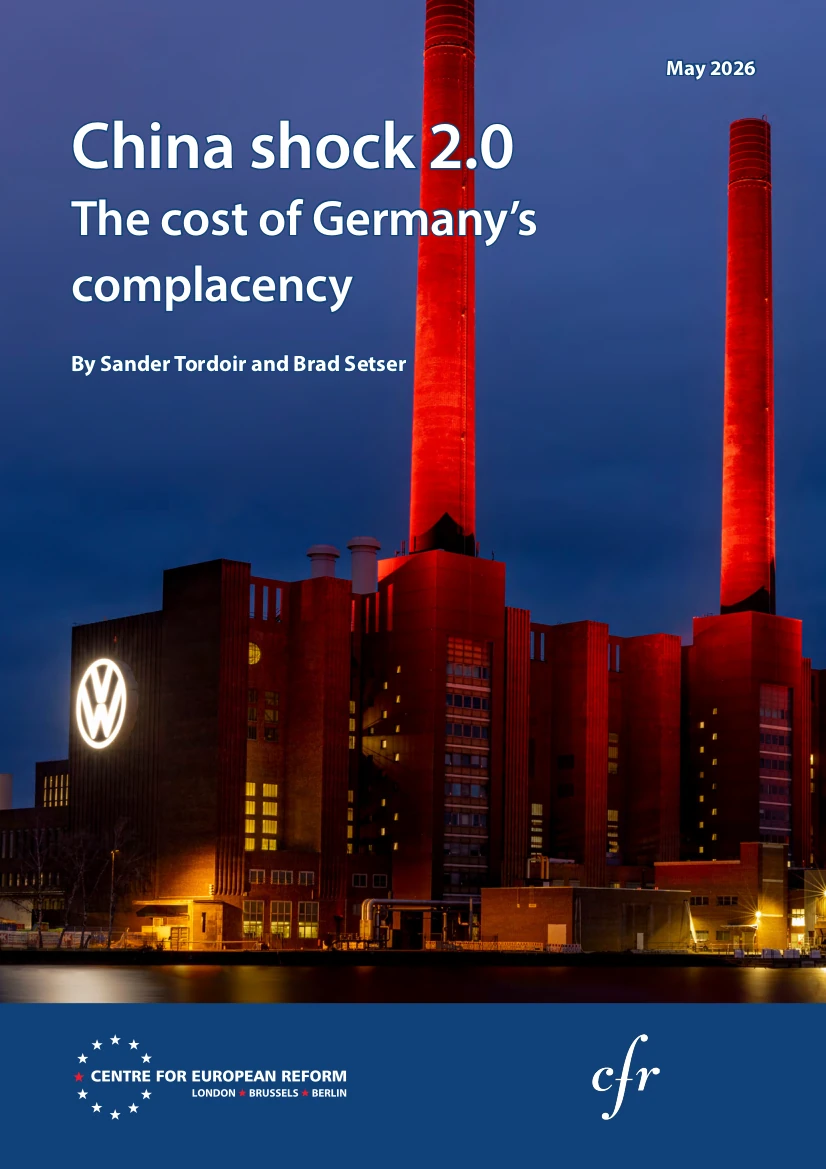
A major new report by Sander Tordoir and Brad Setser (Centre for European Reform / Council on Foreign Relations, May 2026) warns that Germany – and by extension much of European manufacturing – is facing a severe second wave of disruption from China’s export machine.
The Scale of the Problem
Germany’s economy is in a historically unusual slump: industrial production has been falling for six years, private consumption never fully recovered from the pandemic, and GDP remains ~6% below its pre-pandemic trend. The main culprit? A massive loss of export demand, particularly to and from China.
- Chinese export volumes have surged (already hitting 2025 full-year car export targets in Q4 alone), growing at more than twice the pace of global trade.
- German manufacturers in core sectors — cars, machinery, chemicals, aircraft, and clean tech — are being squeezed simultaneously in China, in third markets, and increasingly at home.
- The cumulative drag from declining net exports has reached ~3% of German GDP since late 2023, with more pain ahead.
China’s manufacturing surplus has grown dramatically again, adding nearly another percentage point of world GDP — comparable in scale to the original “China Shock” after its 2001 WTO entry, but this time hitting advanced, high-value sectors that Germany dominates.
Why This Is Happening
The report identifies three persistent drivers in China:
- Extremely high savings / weak household consumption — Property crisis + weak social safety nets keep domestic demand suppressed.
- Massive industrial policy and subsidies — Estimated at 4.4% of GDP (~$800 billion/year), creating chronic overcapacity that must be exported.
- Undervalued renminbi — China actively intervenes to prevent appreciation, boosting export competitiveness. The true undervaluation may be closer to 30% when adjusting for questionable data practices.
Result: China is taking global demand without giving much back through imports. German exports to China have collapsed, and Chinese firms are aggressively expanding into Europe and other markets.
The Solar Industry Warning
The report repeatedly references Germany’s lost solar PV sector as a cautionary tale. Once a leader in equipment, Germany now faces Chinese dominance across the value chain. Similar dynamics are now visible in autos (China already the world’s largest car exporter with huge spare capacity), machinery, and clean tech.
What Needs to Happen
The authors argue Germany can no longer afford complacency. Recommended responses include:
- Stronger, faster trade defences — Move beyond slow, product-by-product anti-dumping cases to broader sectoral safeguards and a potential “European 301” tool (modeled on the US instrument) to address systemic distortions.
- Buy-European industrial policy — Tighten local content rules in subsidies and public procurement (e.g., the proposed Industrial Accelerator Act) to ensure European demand supports European production.
- Reciprocity with allies — Use industrial policy incentives as leverage with partners like the US, UK, Japan, and South Korea.
- Prepare for retaliation — Build compensation mechanisms funded by tariff revenues and reduce critical dependencies (especially rare earths, minerals, and key inputs).
- Push China for rebalancing — Support international pressure for RMB appreciation and stronger Chinese domestic demand.
Bottom Line for Businesses Expanding Abroad
This “China Shock 2.0” is not just a German problem — it is reshaping global competition in advanced manufacturing. Companies with exposure to European industrial supply chains, automotive, machinery, or clean tech need to stress-test their strategies:
- Diversify production footprints and reduce over-reliance on China-centric supply chains.
- Factor in rising trade barriers, localisation pressures, and potential supply disruptions.
- Monitor how European policy evolves toward “strategic autonomy” and friend-shoring.
The report is a stark reminder that waiting for market forces to self-correct risks permanent loss of industrial capabilities. For firms operating internationally, proactive adaptation to this new era of geoeconomic competition will be essential.
Highly recommended reading for anyone tracking global trade, manufacturing, and Europe-China dynamics. The full report is available via the Centre for European Reform.
Can you afford not to expand abroad Talk to us, we’ll help you grow your business internationally.