


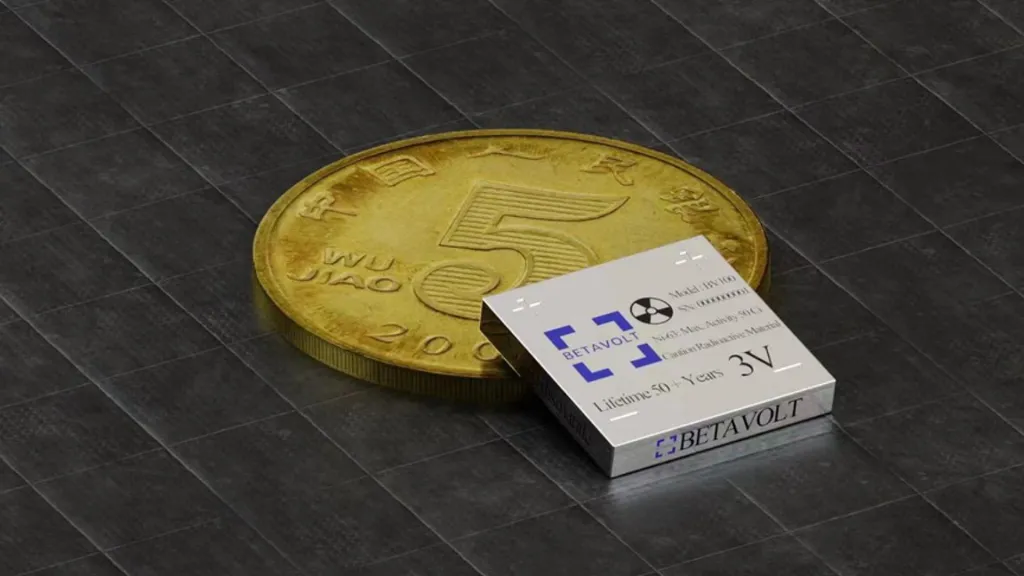
(Image credit: BetaVolt)
For decades, batteries have shared the same fundamental limitation. Whether powering a smartphone, an electric vehicle, a satellite, or a remote sensor, every battery eventually runs out of energy and must be recharged or replaced. Entire industries have been built around overcoming this limitation through larger batteries, faster charging, and more efficient electronics.
A Chinese company believes it has found a radically different solution.
Beijing-based Betavolt has developed a miniature nuclear battery known as the BV100. Roughly the size of a coin, the device uses radioactive nickel-63 and diamond semiconductor technology to generate electricity continuously for up to fifty years without recharging or maintenance.
While headlines have focused on the possibility of phones that never need charging, the real significance of the technology lies elsewhere.
The emergence of commercially produced nuclear micro-batteries could represent the beginning of an entirely new energy sector.
Beyond Lithium-Ion
Modern civilization increasingly depends on batteries.
From smartphones and laptops to electric vehicles and military equipment, portable power has become a strategic resource. Yet even the most advanced lithium-ion batteries suffer from unavoidable limitations. They degrade over time, require charging infrastructure, and lose performance under extreme environmental conditions.
The BV100 operates on a different principle.
Instead of storing chemical energy, it converts the energy released by the radioactive decay of nickel-63 into electricity using ultra-thin diamond semiconductor layers. As long as the isotope continues to decay, the battery continues to produce power.
The result is a power source measured not in hours or days, but in decades.
This concept is not new. Radioisotope batteries have powered spacecraft, remote scientific stations, and medical devices for generations. What makes Betavolt noteworthy is its attempt to miniaturize and commercialize the technology for broader industrial use.
The Power Problem
There is, however, an important caveat.
The current BV100 generates only around 100 microwatts of power. That is enough for low-power sensors and specialized electronics, but nowhere near the energy requirements of modern smartphones, laptops, or electric vehicles. Experts note that the current design produces only a tiny fraction of the power needed by consumer electronics.
This reality has led many observers to view the technology with skepticism.
Online discussions frequently point out that the battery is better described as a long-term power generator than as a replacement for conventional batteries. Others argue that its true value lies in autonomous systems rather than consumer devices.
Betavolt appears to recognize this limitation. The company has announced plans for a one-watt version, a substantial increase over the current design, although still below the requirements of most power-hungry electronics.
Why Governments Care
The most important applications may not be consumer products at all.
A battery capable of operating for decades without maintenance could transform industries that depend on remote infrastructure. Sensors monitoring pipelines, bridges, rail networks, shipping containers, military installations, satellites, and environmental systems could operate for years without human intervention.
This has clear strategic implications.
Governments around the world are investing heavily in autonomous systems, artificial intelligence, space infrastructure, and sensor networks. All of these technologies require reliable long-duration power sources.
A battery that can survive for decades without maintenance offers obvious military and economic advantages.
The technology also aligns with a broader trend visible in China’s industrial strategy: achieving leadership in foundational technologies before they become mainstream markets.
The Diamond Semiconductor Advantage
Perhaps the most overlooked aspect of the BV100 is not the radioactive isotope but the semiconductor technology.
Betavolt’s design relies on ultra-thin diamond semiconductor layers that convert beta radiation into usable electricity. The company claims expertise in manufacturing these specialized materials, an area that remains relatively niche compared to traditional silicon-based electronics.
If such technologies mature, they could have implications beyond nuclear batteries.
Diamond semiconductors are being studied for high-temperature electronics, advanced power systems, aerospace applications, and next-generation computing environments where conventional semiconductors struggle.
In other words, the battery itself may be only one application of a broader technological capability.
A New Energy Frontier
Whether Betavolt ultimately succeeds remains uncertain.
The company’s ambitious claims have attracted both excitement and skepticism. Some observers question whether nuclear batteries can be produced economically at scale, while others raise concerns regarding regulation, public acceptance, and safety standards.
Yet the broader trend is undeniable.
Around the world, governments, universities, and private companies are exploring miniature nuclear power sources for applications ranging from medicine and aerospace to robotics and industrial monitoring. The race resembles the early days of lithium-ion technology, when few anticipated how profoundly rechargeable batteries would reshape the global economy.
The most disruptive technologies often begin in niche applications before expanding into mass markets.
Today, the BV100 cannot power a smartphone.
But if long-life nuclear batteries continue to improve, future generations may power systems that operate for decades without human intervention.
The result would not simply be a better battery.
It would represent an entirely new category of energy infrastructure.
And once again, China appears determined to be among the first movers.
Can you afford not to enter the Chinese market? Talk to us, we’ll help you succeed in China.
Talk to us →